
Larimar
Blue Amber
Green Amber
Amber Carvings
More

by Admin August 30, 2026 5 min read

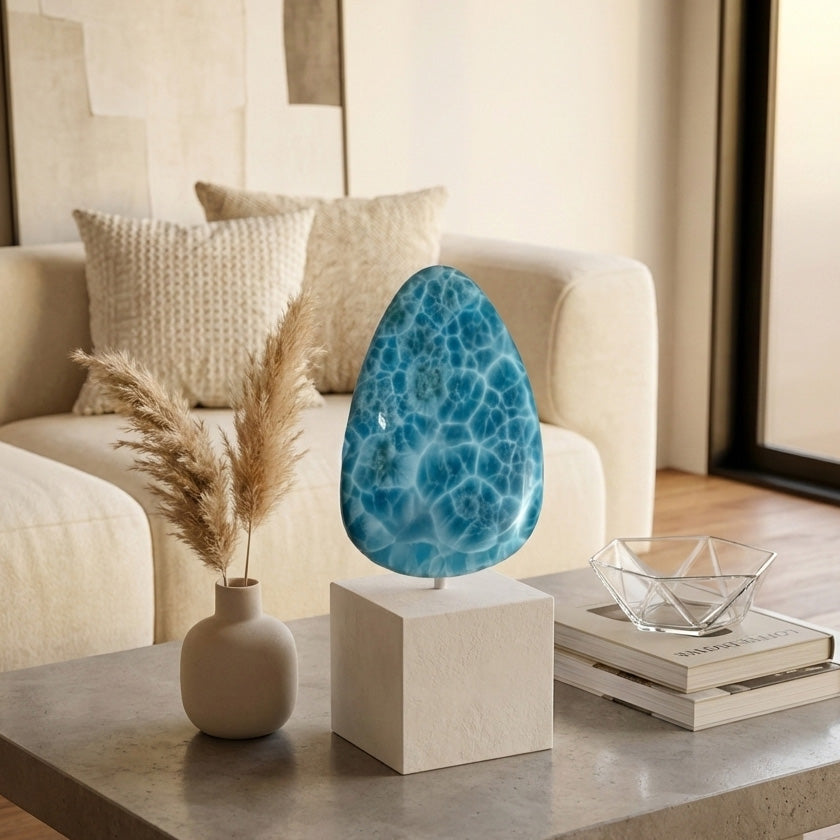
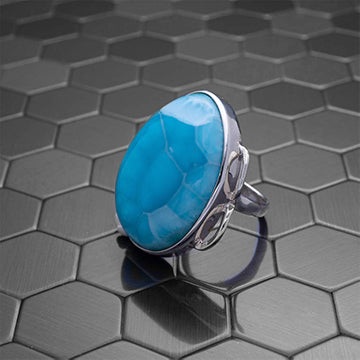
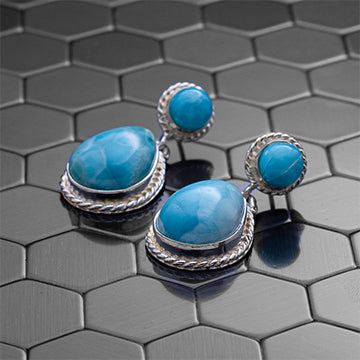
A fine Larimar stone can seem to hold a moving piece of the Caribbean sea: pale foam, sunlit shallows, and deep blue water captured in a single cabochon. But what makes larimar blue is not romance alone. Its remarkable color begins with a rare mineral, trace elements of copper, and the singular volcanic geology of the Dominican Republic.

Unlike stones whose beauty can be reproduced at scale, genuine Larimar owes its appearance to a specific set of natural conditions that occurred in one small part of the world. That is why every authentic piece has its own pattern, depth, and character.

What Makes Larimar Blue in the First Place?

Larimar is the blue variety of pectolite, a silicate mineral that is more commonly white, gray, or nearly colorless. Pectolite itself is not naturally destined to resemble the ocean. The exceptional blue associated with Larimar appears when small amounts of copper become incorporated into the mineral as it forms.

Those copper ions absorb portions of visible light and create the blue coloration collectors admire. The amount and distribution of copper are not uniform from one stone to another, which is why Larimar can range from a soft, airy sky blue to a more saturated turquoise-blue or deep volcanic blue. A stone may show several tones at once, often flowing together in cloudlike or wave-like patterns.

This is also why color cannot be judged by a label alone. Two genuine Larimar gems can both be beautiful while looking entirely different. One may be bright and open, with delicate white veining. Another may have concentrated blue islands set against a pale pectolite ground. Nature does not repeat the same design twice.

A Blue Stone Born From Dominican Volcanic History

The color story becomes even more remarkable when you consider where Larimar formed. Authentic gem-quality Larimar is found in the Dominican Republic, in the mountainous region near Bahoruco in the country's southwest. This limited origin is central to both its rarity and its identity.

Millions of years ago, volcanic activity and mineral-rich fluids moved through cavities and fractures in the surrounding rock. Under the right conditions, pectolite crystallized within those spaces. Copper present in the mineral environment contributed the blue color that separates Larimar from ordinary pectolite.

The exact balance mattered. Mineral chemistry, pressure, temperature, and the movement of fluids all played a role in determining how much blue developed and how it appeared within the stone. It was a geological event with an unusually elegant result: a Caribbean gemstone whose colors echo the waters near its only known commercial source.

Because the deposits are limited and mining is demanding, Larimar is not an endlessly available material. Rough is recovered from narrow underground workings, then carefully cut to reveal the most compelling sections of color and pattern. A finished pendant, ring, or carving represents both geological rarity and the work of a skilled artisan who understands where the stone will come alive.

Why One Larimar Looks Bluer Than Another

Copper provides the foundation of Larimar's color, but several factors affect how blue a finished gem appears. The first is concentration. In general, a greater and more evenly distributed presence of copper can produce stronger blue areas, though the visual result still depends on the stone's structure and pattern.

The second is the presence of white pectolite, calcite, or other mineral inclusions. White is not a flaw by default. In fact, the airy white markings that cross a blue Larimar cabochon are part of the look many people cherish. They can resemble sea foam, clouds, or the ripple of water over sand. The trade-off is simple: stones with more white often appear lighter, while pieces with broad, clean fields of rich blue are usually scarcer and more highly prized.

Natural fractures, tiny cavities, and darker mineral material may also appear in rough Larimar. An experienced cutter studies these features before deciding how to shape the stone. Cutting too deeply can sacrifice valuable blue. Cutting too shallowly may leave a surface that does not show the color at its best. The right dome and orientation can give Larimar greater depth, allowing light to travel through the polished surface and emphasize its layered blue character.

Lighting matters, too. A Larimar gem may look especially vivid in natural daylight, while warm indoor light can make its blue seem gentler. This is not the dramatic color-change phenomenon seen in some gems. It is simply the familiar effect of viewing a blue stone under different light sources. When selecting Larimar jewelry, look at photographs or the piece itself in more than one setting whenever possible.

The Most Desired Shades of Blue Larimar

Color is one of the most significant factors in Larimar's appeal and value, but the best shade depends partly on personal taste. Collectors often seek a clear, saturated blue with minimal distracting inclusions. In the trade, intensely colored material is sometimes described with evocative names such as volcanic blue or ocean blue.

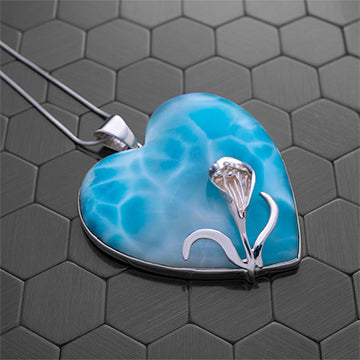
Still, a deep blue field is not the only expression worth wearing. Pale blue Larimar can feel serene and luminous, especially in larger pendants and heart-shaped designs. Stones with white marbling carry a distinct sense of movement. Greenish or grayish undertones may be less traditionally desirable to buyers seeking classic Caribbean blue, yet they can create an earthy, individual look in artisan jewelry.

A refined Larimar selection considers more than darkness of color. The most compelling gems balance hue, saturation, polish, pattern, and proportion. A bright blue cabochon with a flowing natural design may be more captivating than a darker stone with a dull surface or poorly placed fracture line. The stone should feel alive when it catches the light.

Larimar Is Not Turquoise, and It Should Not Look Artificial

Larimar is sometimes compared with turquoise because both can display blue to blue-green tones. They are entirely different gemstones, however. Turquoise is a phosphate mineral, while Larimar is blue pectolite. Their structures, origins, and visual signatures are distinct.

Genuine Larimar usually has a softer, more clouded or watery appearance than turquoise. Its white veining tends to look integrated into the body of the stone rather than forming a dark, web-like matrix. It also has a particularly smooth, silky look when cut and polished well.

Authenticity matters because rare stones invite imitation. Some materials may be dyed, reconstituted, or simply marketed with misleading names. An unnaturally uniform, electric color across a large quantity of low-priced stones deserves closer attention, especially if the material lacks the nuanced variation typical of natural Larimar.

Trustworthy sourcing is the most meaningful protection. Ask whether the gemstone is natural Larimar from the Dominican Republic, whether any treatments have been disclosed, and whether the seller can stand behind the stone's origin. At Larimar Creations, the focus is on authentic, certified Dominican gemstones and workmanship that honors the material rather than disguising it.

How to Preserve Larimar's Natural Blue

Larimar is beautiful enough for everyday wear, but it benefits from thoughtful care. With a Mohs hardness generally around 4.5 to 5, it is softer than sapphire, diamond, and many common jewelry stones. A Larimar ring will encounter more knocks and abrasion than a pendant or pair of earrings, so setting design and daily habits both matter.

Remove Larimar jewelry before strenuous activity, housework, swimming, or applying perfume and hairspray. Avoid ultrasonic cleaners, steam cleaning, harsh chemical solutions, and prolonged exposure to intense heat. Clean the stone gently with lukewarm water, mild soap if needed, and a soft cloth, then store it separately from harder jewelry that could scratch its polished surface.

The blue in Larimar was formed by nature over immense geological time. Wear it with the same care given to any rare Caribbean treasure: let its color be seen, let its story be shared, and choose the piece whose waves, clouds, and blue depth feel unmistakably yours.

Natural Stone Jewelry: Your 2026 Guide to Gemstone Quality - Larimar Creations

Natural Stone Jewelry: Your 2026 Guide to Gemstone Quality

9 min read

Discover how to choose, care for, and style natural stone jewelry in 2026. Expert guidance on quality, authenticity, and the beauty of gemstones.
Read More
A Guide to Amber Fluorescence and Blue Amber - Larimar Creations

A Guide to Amber Fluorescence and Blue Amber

6 min read

Our guide to amber fluorescence explains blue amber's glow, UV testing, authenticity limits, and how to choose a rare Caribbean gemstone with confidence.
Read More
Large Pendant Necklace: Style Guide & Buying Tips - Larimar Creations

Large Pendant Necklace: Style Guide & Buying Tips

11 min read

Discover how to choose, style, and care for a large pendant necklace. Expert tips on materials, proportions, and making statement jewelry work.
Read More